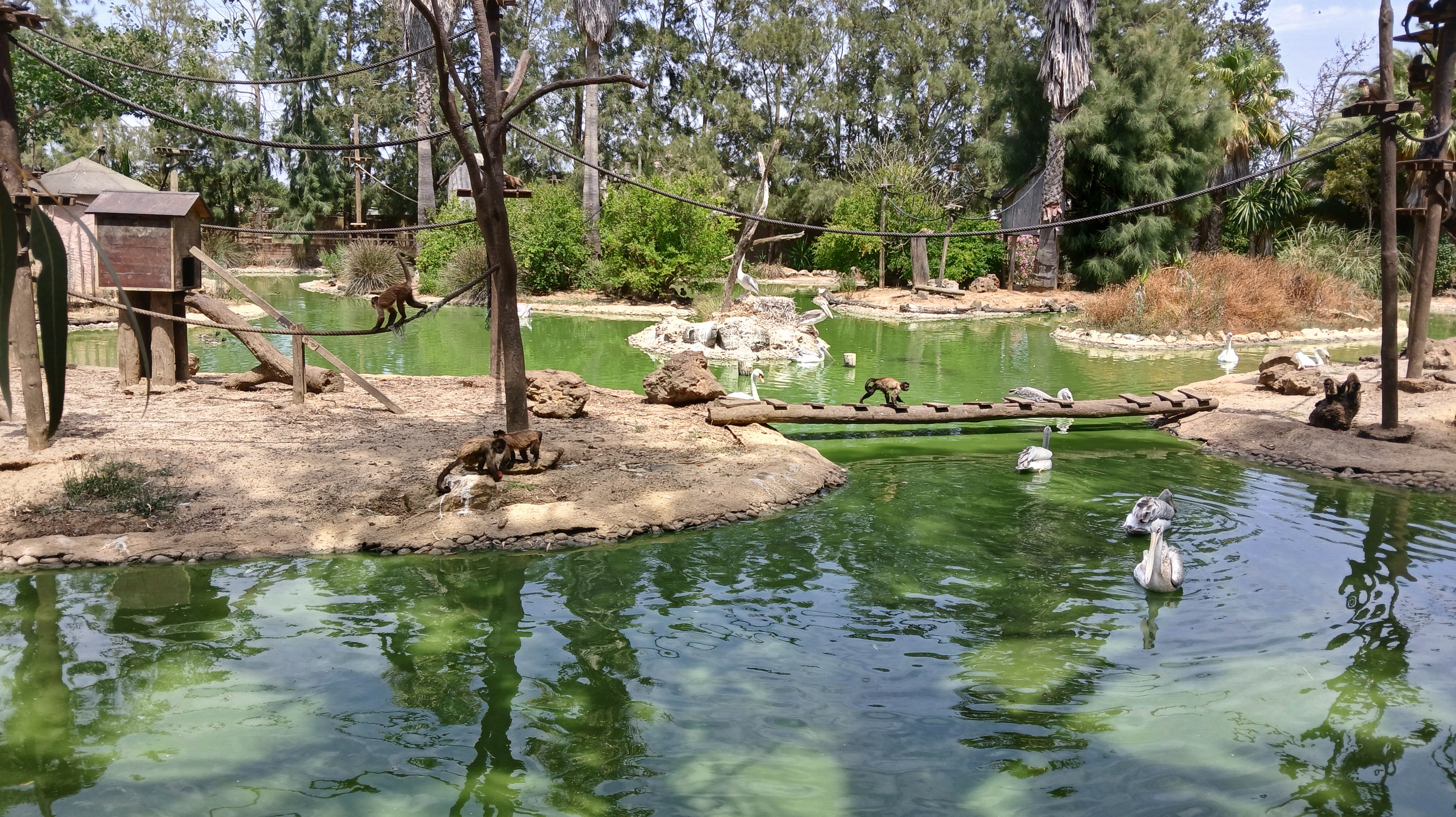
On June 23, 2026, we visited the zoo in the southern Portuguese city of Lagos. We were staying nearby and were honestly also looking for some cool relief. At that time, Europe was suffering from exceptionally high temperatures: a widespread heatwave that was most likely caused mainly by human activities. Lagos Zoo was recommended to us as a beautiful and shaded garden, where there was plenty to see. Indeed, the zoo turned out to be lovingly maintained and provided a pleasant reminder of the immense richness of the earth’s plant and animal life. At the entrance, there were wise admonitions from David Attenborough and others, such as this one from Gandhi:
“The greatness of a nation and its moral progress can be judged by the way its animals are treated.”
And this one from Pythagoras:
“Educate the children, and it won’t be necessary to punish the men.”
These admonitions also made leaving the zoo heart-wrenching. Despite the educational and ecological programs of the zoo, we encountered nearby the signs with quotes a souvenir shop – clearly connected to the zoo – that sold almost exclusively plastic items, often in the form of stuffed animals, obviously intended for children. The items were made from highly polluting materials like fleece, a polyester imitation of animal fur.
Suppose we had our grandchildren with us; they would first be confronted with endangered species in the zoo. At the exit, they would then be bombarded with one of the causes of that extinction and their own polluted environment, namely plastic, this time in the form of souvenirs to remember the zoo. The cynicism of that cognitive dissonance was too much for us.
At the exit (also the exit of the souvenir shop), we came across a guest book, and we couldn’t help but leave a message asking if the sale of plastic as a reminder of the visit to the zoo could stop. The extent of pollution on our planet caused by plastics is immense (and is accelerating dramatically), and the sale of plastic stuffed animals by zoos is grotesque in this light. Moreover, there are plenty of other souvenirs imaginable, made from natural materials and produced artisanally.
The plastic toys turned out to be partially available online through the ‘zooshop,’ where they are offered as “A lovely souvenir to take home after visiting the zoo.” We would have loved to buy a souvenir made of less plastic to support the zoo, and indeed found items made of cork and cotton, but still left the place disheartened, as if the zoo was part of the current immense crime against the nameless and the unborn. We are convinced that this is not the intention of Lagos Zoo or any other zoo. Somehow, this must have escaped the management’s attention. We are all swimming, so to speak, in highly polluted water, and we have gotten so used to it that we no longer even see what water we are swimming in. Yet, the words of Sir David Attenborough, also quoted by Lagos Zoo, hold true here:
“It’s surely our responsibility to do everything within our power to create a planet that provides a home not just for us, but for all life on earth.”
Hence our friendly reminder of the still valid quotes that were cited by Lagos Zoo itself at the entrance and exit of the zoo. Hopefully, we will not find any plastic items in the souvenir shop upon our return. The zoo is open to compliments and complaints but follows a strikingly bureaucratic path for this, requiring even one’s personal VAT number to progress to the second page of the four online pages of the complaint form. We didn’t bother with that effort. But we do take this effort: here begins a small battle against the windmill, namely the seemingly still largely unchallenged notion of plastic toys in the adjoining gift shops of zoos.
Too have an idea about what’s going on:
https://www.researchandmarkets.com/reports/6141444/ai-generated-plush-toy-market-global-forecast
noplasticanimalsinthezoo foi fundado no dia 23 de junho de 2026 em Lagos, Portugal por
Leon Dessau
Thalia
João
 Leon Dessau